

Unexpected pleasures

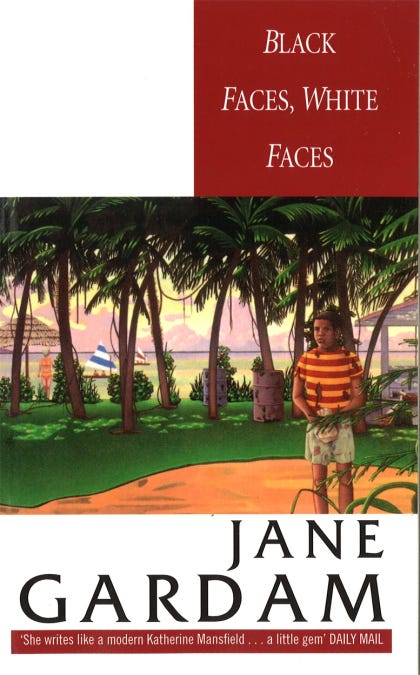
I picked up Jane Gardam’s remarkable book of connected short stories, Black Faces, White Faces, while in Oxford a couple of weeks ago. I dashed into Oxfam Books on a dreary, wet Friday afternoon, looking for something - anything - to read, as I had somehow forgotten to pack my book when frantically chucking my things into my overnight bag that morning. I didn’t have long - my colleague and I were accompanying our students on a three day conference, and during a lecture, my colleague had said she’d hold the fort while I went out for a quick breath of fresh air. For such a bookish town, the Oxfam Books in Oxford never has that great a selection - perhaps it’s because no one in Oxford gives away their books?! - and as my eyes scanned over the shelves, I failed to see anything that really sparked my interest. Then, suddenly, I saw the magical name of Jane Gardam leaping out at me, and I plucked this slim little volume off the shelf. I read the blurb - ‘Jamaica in the off-peak season: brilliant sun, clear blue skies, neatly raked beaches, cool cocktails and swimming pools…But beneath the idyllic surface cross-currents of tension and terror threaten to sweep the complacent holidaymakers out of their depth’ - and was immediately sold. Jane Gardam’s Old Filth series of books were probably my favourite contemporary reads of this year, and so I was delighted to have another world of hers in which to absorb myself.
I didn’t have any time to flick through, so when I started reading on my return to the conference, I realised I’d inadvertently bought a book of short stories rather than a novel. I’m not normally a fan of the short story form, but these are all so perfectly, exquisitely crafted portraits in miniature that I found myself entirely satisfied by them regardless. Set in the time they were written - the early 1970s - amongst the largely English, wealthy guests of a high end Jamaican hotel, the short stories explore their adventures and misadventures as they attempt to navigate an environment that both fascinates and repels them. One of my favourites was the tale of two ancient school mistresses, who leave their Harrogate school for the first time in their lives to take a holiday in Jamaica, and whose terrifying journey up into the hills in a rainstorm, with one of them driving a car for the first time since driving an ambulance in the war (the first one!) could so easily have been a horrific tragedy, but instead descends into the most glorious farce. I also loved the story of the honeymoon of an impossibly young and impossibly well-heeled couple, who are hopelessly in love until they get caught in a rainstorm and their car breaks down. Their differing responses to crisis give them both their first proper glimpse of the person they have married - and to their horror, neither of them like what they see.
All of the stories are pictures of personal drama and disappointment, interspersed with a wicked sense of humour, as well as an undercurrent of unease and uncertainty, as befitting the setting of a paradise island that functions as a playground for rich white people, while being a place of poverty and limited opportunity for the local population. Everyone in these stories isn’t quite who they present themselves as being - everyone is hiding some secret desire, or unspoken truth. The most striking story is probably that told from the perspective of a man who has had a stroke and lost his ability to communicate - his commentary on what he sees and how he feels about his life is presented alongside what his loud, relentlessly cheerful wife tells everyone he is feeling, revealing the gulf of understanding that has always existed between them. His silent desperation is truly haunting.
These stories are in some ways very much a period piece, exploring the lives of a narrow pool of wealthy upper-middle class people whose troubles are largely self-inflicted. Gardam’s choice to explore the lives of these characters while they are on holiday in a place known for its connections to slavery allows her to begin to explore the impacts of colonialism in their often selfish and self centred behaviour, and the absence of any Black voices within the text despite these characters’ constant presence on the margins of the action, is a stark reminder of how the protagonists give so little thought to anyone outside of the confines of their own privileged worlds. I was reminded of Jamaica Kincaid’s remarkable essay about Antigua, A Small Place, and the corruption and damage caused by it being used and abused as a playground by white tourists, and I wondered whether, if Gardam were to write these stories again now, she would have something more explicit to say along these lines. I would hope so.
I don’t think I would have come across this brilliant little set of gems if I hadn’t have ducked into Oxfam Books in a moment of desperation, and I’m so glad I did. I’d love to hear from anyone else who has read them - and I hope I have encouraged some of you to give them a try.
Thanks for this excellent recommendation, Rachel. Like you, I'm not a great fan of short stories (unless it's Claire Keegan!) but I got this from the library last week and you're so right, it's brilliant - and so beautifully structured.
Thank you for this recommendation. Although I have long been a fan of Jane |Gardam (and short stories) I had never heard of this title. I'll be looking out for it from now on.