

Sheep's Clothing

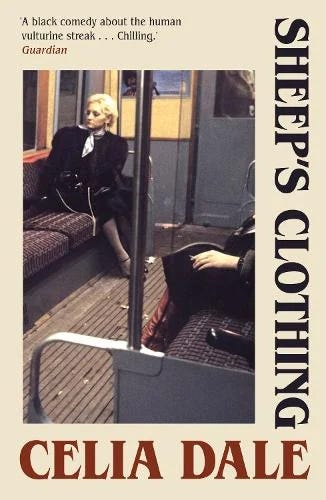
Daunt Books republished one of mid-to-late 20th century writer Celia Dale’s noir (I’m wondering if there’s a genre for female noir writers - feminoir?!) novels, A Helping Hand, last year, which I enjoyed very much but found lacking a little bit of ‘punch’. When I saw Sheep’s Clothing being advertised in Daunt the other week, after reading the blurb, I thought this might provide me with the punch I had been looking for previously. Two female ex-cons, one scam, several elderly victims - not a premise I have ever come across before, and one I was very keen to try. And I'm glad I did!
Grace is in her fifties and has spent her life ducking and diving, after enduring a chaotic, poverty-stricken and loveless childhood. An early wartime marriage quickly over, she has spent her life ‘looking after Number One’ ever since, interspersing periods of legitimate employment with ‘schemes’, the latest of which has ended her up in Holloway Prison for six months under a larceny charge. In Holloway she meets Janice, a vague, uneducated twenty-something survivor of childhood sexual abuse, whose lack of sense means holding down a job has never been easy, hence her forays into shoplifting. On landing in Holloway, she cleaved herself to Grace as a form of protection. Soon Grace saw that Janice could be a very useful sidekick in her next scheme, once they both get out of jail - not the type to ask questions, easily biddable and someone to enjoy bossing around, she’d certainly be more of a help than a hindrance, and a bit of company in the evenings, too. Once released and ensconced in a grimy North London flat share, they begin Grace’s latest money making scam - posing as social security workers, they will visit elderly women who live alone, and tell them that they are due backdated benefits. While Grace gets out her official looking forms, Janice makes the tea, slipping in a sleeping pill as she does so. Once the old lady is asleep, the pair whip round and take everything worth any cash, and make a quick exit, later flogging anything they’ve got hold of on various markets around the city.
Grace loves the thrill of scoping out her potential victims, spending hours on her designated research days in local libraries, post offices or high street shops, looking for women out on their own, and preferably having just drawn their pensions. She follows them home, makes a note of their addresses, then when she has enough in one area, she and Janice strike. Grace loves the order and method of it all, and has strict rules for Janice to follow to ensure they don’t get caught. Whenever Janice questions anything, Grace soon reminds her who keeps a roof over their head, and Janice, beaten into submission, largely does as she’s told. That is, until she begins to long for something more.
One night, Janice goes out to a pub by herself, and meets ‘Dave’, a mysterious, handsome man her own age who won’t tell her who he works for, and seems just as happy to not know very much about Janice. They begin a loose relationship, mutually agreeing to meet up every few days, but never swapping numbers, or addresses. Once Grace finds out, she forbids Janice from seeing him again, as forming any permanent connections could blow their cover. But Janice believes herself to have fallen in love, and can’t give Dave up. She starts to dream of a different life, one where she might have a home of her own with Dave. However, is Dave all he seems?
Meanwhile, Grace has started to get fed up with Janice, and has her eyes on a bigger prize. Her regular Sunday night outing, ‘up west’, to a pub at Tottenham Court Road, where she goes alone to see ‘a bit of life’, has resulted in a casual acquaintance with Conroy, a man of her own age who seems to be quite well-to-do. Over several weeks, Grace plays a game of cat-and-mouse with him, until eventually he invites her to his home for tea with his mother. Grace thinks she has the measure of the situation, but his mother turns out to be a redoubtable woman, and not quite what she had expected. However, a nasty accident befalling the old woman presents an opportunity Grace can’t pass up. But will Conroy be the man she thinks he is, and the way to the easier life she secretly craves?
Both Grace and Janice are deeply damaged and lonely women, and this portrait of the uneasy relationship between them is troubling and unnerving to read. Grace has no morality, no sense of wrongdoing, guilt, or shame. Everything she does is for her own good, and as much as she tells Janice that she’s lucky to have her looking out for her, she only looks out for Janice in the sense of ensuring that her actions don’t put Grace’s scheme in danger. Dale gives us only the sketchiest portrait of Grace’s past, and there is little to go on to understand how she has become so devoid of humanity. However, the picture she paints of the dingy, uninspiring worlds Grace has always moved in, and the lack of any affection she has ever received from anyone, does give a glimmer of insight into how a woman like Grace could become as cold-hearted yet craving of comfort as she is. Janice is the more tragic of the two; she is not mean spirited or unkind, just easily led and lacking in any confidence. She is desperate to love and be loved, but her childhood abuse makes it difficult for her to understand what either of those things look like. If she hadn’t have fallen into Grace’s clutches, she may well have had a very different fate.
Dale’s interest in women who transgress the expectations of femininity and domesticity are so unusual, and while I was troubled by the world she creates on the page, I also found myself utterly transfixed by it. Like Mary Elizabeth Braddon in her sensation novel Lady Audley’s Secret, she’s not afraid to give women the same potential for villainy as men, and neither does she feel the need to psychologically justify their behaviour in any great depth. Grace robs people because she likes it, and that’s all there is to it. It’s important, I think, to have novels like this that show women in this light - manipulative, scheming, lacking in morality - to challenge the social stereotypes that depict women as somehow being innately kinder than men. There is a delicious irony, too, in Grace’s scheme working precisely because she and Janice are women - for who would suspect two smartly dressed women knocking on their door as being anyone other than who they said they were?
I’ve also not read a lot of fiction written in the 80s, the decade of my birth, and I was fascinated by the descriptions of London, interior design, food and high street shops that I’ve heard about from my parents and seen in their faded Polaroid photo albums, but never really seen come to life on the page. It was strange to think of this setting as having existed during my own life time - when Janice has no way of contacting Dave outside of a communal telephone number, when people withdrew a week’s worth of cash from banks in one go because debit cards didn’t exist yet, when bomb damage was still visible on London streets and you could drive around an empty London on a weeknight and park outside a pub on Tottenham Court Road - madness!
I really can’t recommend this highly enough - Dale is such a talented writer, and the way she slowly tightens the screws to build the tension in this novel is such a work of art. She also has a fantastic ear for dialogue - Grace’s voice is so brilliantly done - and I relished every single page. I so hope Daunt will republish more of Dale’s back catalogue - her other novels are so hard to get hold of, and I’d love to read more.