

Middlebrow Midwinter

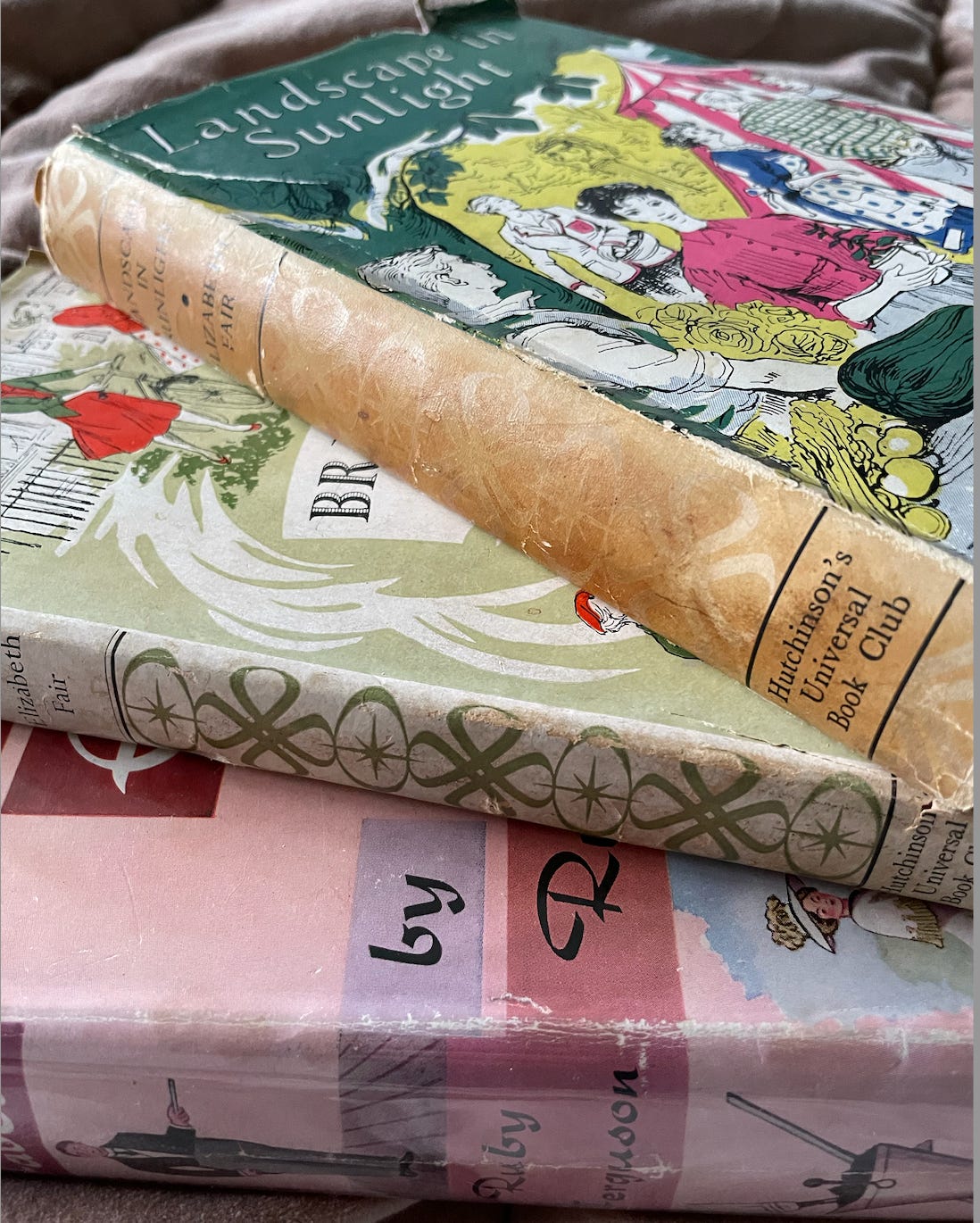
These lazy last few days before Christmas are such a treat after the manic activity of the first school term of the year. Having a week to wind down and gear up for the festivities is just what the doctor ordered. I’ve been busy, but pleasantly so - there’s been a carol concert, a night at the Barbican listening to ‘Christmas at the Movies’, cosy coffee and cake à l’Autriche at my favourite local café, Kipferl, a trip to the cinema to see ‘Wonka’ (which I very much enjoyed as a piece of undemanding whimsy), a family ‘fake’ Christmas, and a glorious wander around Hever Castle’s Christmas lights show and fair, including a ride on the merry-go-round (my sister and I loved it so much we went on twice!). There’s also been plenty of time to put my feet up and read, and I have been having a Middlebrow Midwinter, in that I’ve allowed my brain to rest and indulge itself in reading what it likes best during these short, dark days when the sun rises late and sets early, and the body and mind long for hibernation and stillness. In preparation for this, I treated myself to a few books by middlebrow writers I’ve long liked but not read widely, and what a fabulous time I’ve had devouring them this week, while lingering over tea in bed in the mornings, and enjoying a little Mrs Miniver-esque tea tray on the sofa during the lamplit afternoons.
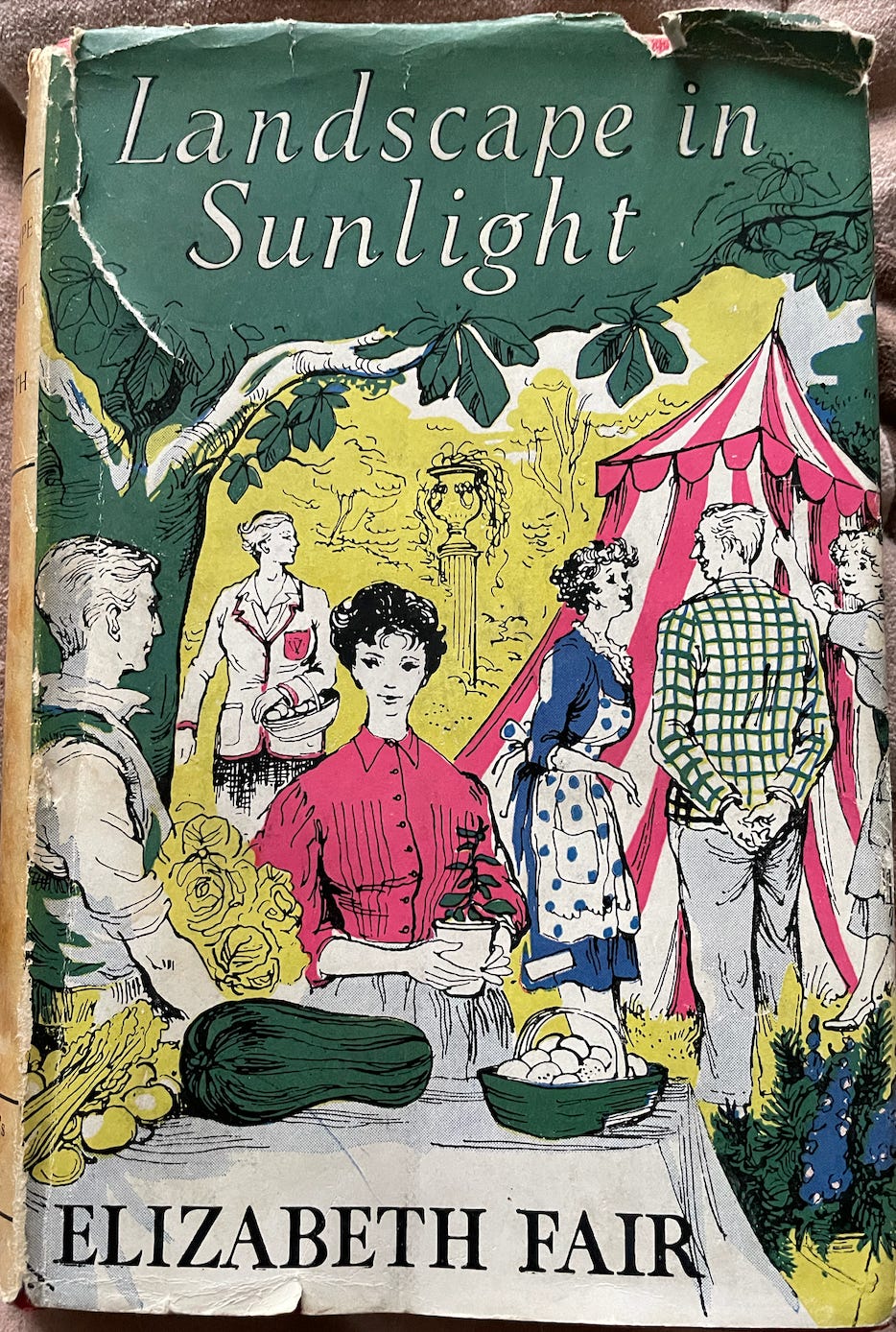
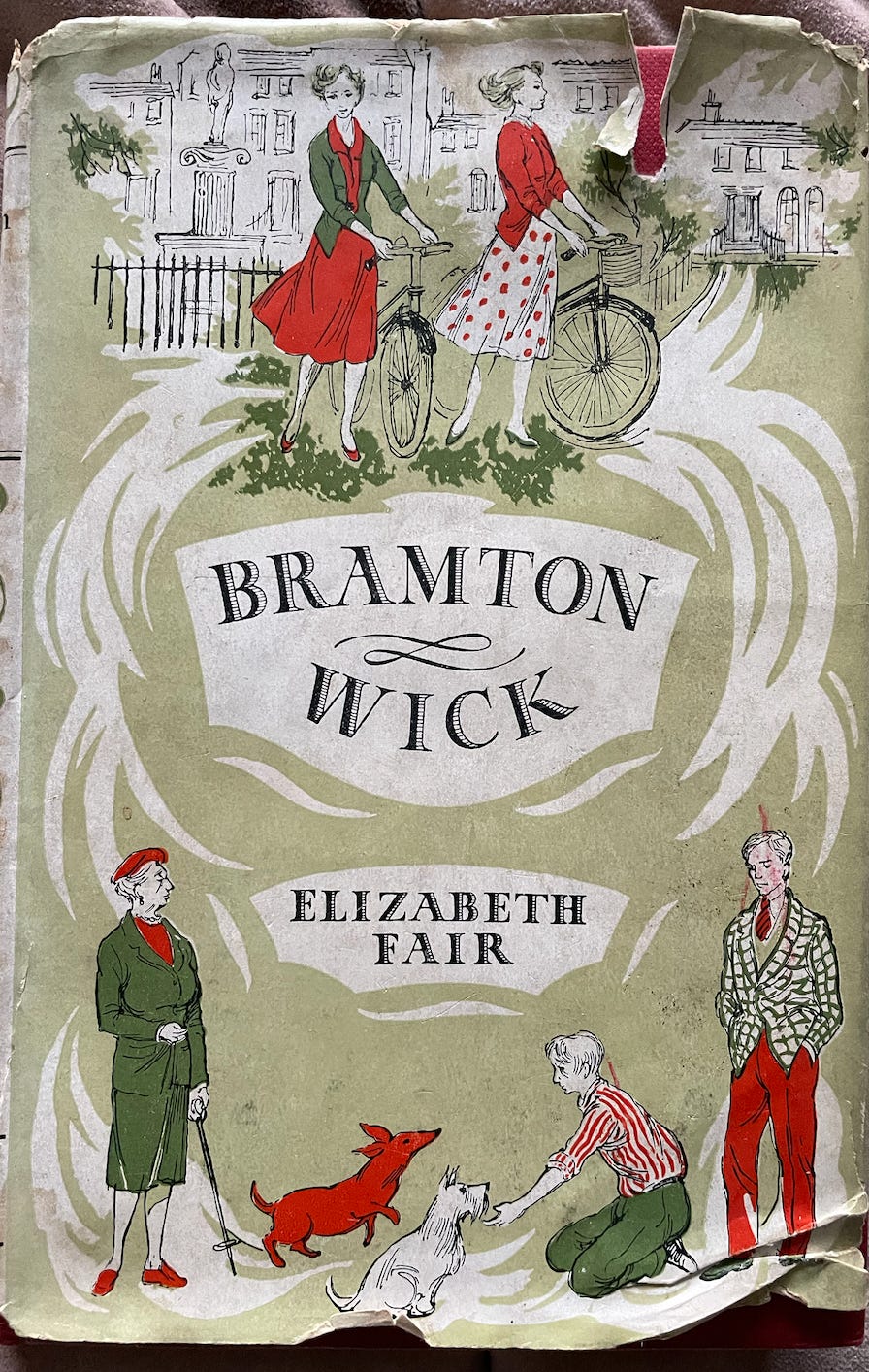
I first read a novel by Elizabeth Fair several years ago, when Dean Street Press started republishing middlebrow authors who had otherwise been lost to the midsts of time. I remember liking A Winter Away very much, experiencing plenty of laugh out loud moments, and finding her style very similar to Barbara Pym, though slightly less caustic and with a little more whimsy. I can’t imagine why it’s taken me so long to get to another book of hers, but when I saw a gorgeous 1950s copy of Landscape in Sunlight going very cheaply on eBay a couple of weeks ago, I decided to take the plunge. Set in the village of Little Mallin, the book tells the story of one summer in the lives of its residents, though it largely revolves around Mrs Custance, the vicar’s wife, and her preparations for the church summer fête (known as the Day to everyone in the village), as well as her concern over her twenty-something daughter Cassandra’s lack of direction in life. Cassandra is quite happy whiling away her days as a governess, but when her childhood friend George, the wayward son of the local aristocrat, comes back on the scene, she finds herself unsettled. Alongside the Custance’s domestic woes are those of the Templars. Cassandra is the governess to the nephew of Eustace Templar, a once famous portrait painter who retired to the country in a huff many years before and now hates any mention of artists. He lives in a rambling old pile with his marvellous hippy of a spinster sister, Isobel, and their fastidious brother in law Colonel Ashford, who finds the ramshackle nature of life in the Templar household unbearable. Colonel Ashford’s main goal in life is to find a house of his own, and quickly (he is staying with the Templars while his wife recovers from an operation), but houses in the village are hard to come by. Eustace Templar owns a very pretty cottage at the end of the lane that would be perfect, but it is currently occupied by the village martyr, Mrs Midge, and her insipid, over-indulged son Lukin, who fancies himself the next young thing in the art world. The two are ‘utterly devoted’ to one another, but much to Mrs Midge’s dismay, Lukin, with the encouragement of Lily, the newly home from school niece of the Templars, is starting to develop a desire for independence. Eustace and Isobel would dearly love Mrs Midge - who Mrs Custance considers in the category of ‘people we could do without’ - to move on so that Colonel Ashford can move in. Can Lily and Cassandra’s cunning plan to encourage Lukin to set himself up as a Real Artist be a solution to the problem? Throw in a good amount of village gossip, misunderstandings, fears of poor weather and the petty disagreements that so often cause battle lines to be drawn in rural communities, and you have an absolutely brilliant comedy of manners that would give Jane Austen a run for her money. I would actually say that this is better than Barbara Pym, and that really is saying something. I couldn’t stop laughing while reading it - there are so many brilliantly observed moments and fantastic lines of dialogue that made me stop in my tracks and think - my goodness, this is such fabulous writing. So fabulous in fact, that the moment I finished, I went straight online and bought a copy of her first novel, Bramton Wick, which is just as entertaining and funny, though the characters are not quite as memorable as in Landscape in Sunlight. I now consider myself an Elizabeth Fair addict, and look forward to exploring the rest of her oeuvre in the New Year.
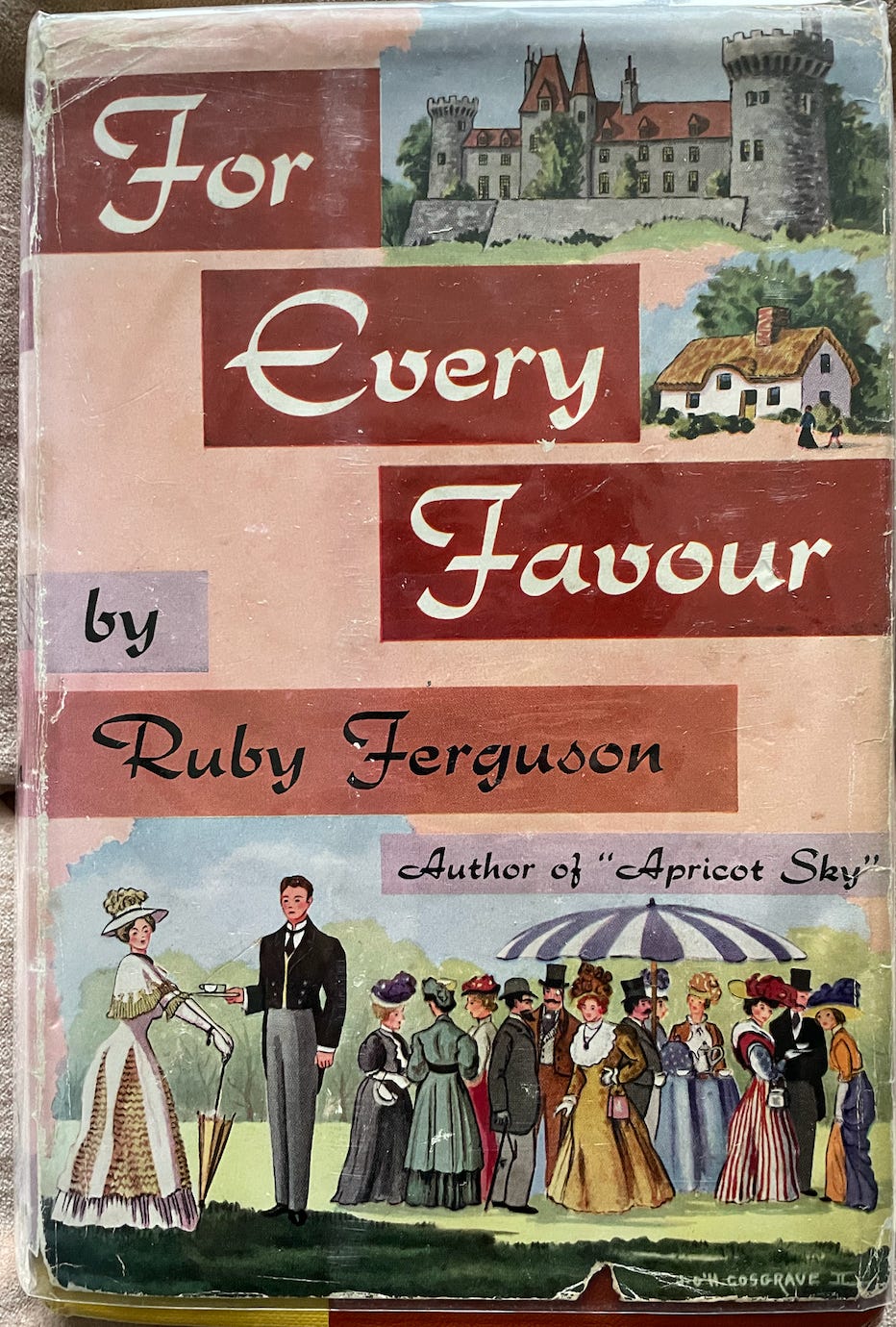
Alongside these two marvellous novels, I have been absorbed in Ruby Ferguson’s (of Lady Rose and Mrs Memmary fame, one of my favourite Persephone reprints) For Every Favour, which had such a beautiful dust jacket that I bought it on a total whim, without knowing anything about the actual story (and when it arrived, I found it was also signed by Ruby Ferguson - what a bonus!). It wasn’t at all what I had expected, but it is brilliant nonetheless. It is the story, from childhood to old age, of Eddie Boan, a poor gardener’s boy born in the 1880s, who aspires to become a butler. We see him work as a pantry boy and valet in his first couple of jobs, in which there are many ups and downs while he is earning his stripes, before he goes to Merryns, a beautifully run Edwardian country house occupied by Lord and Lady Cedely and their young family. Merryns is an idyll that for Eddie will always be remembered as the happiest time of his life. This is largely due to his unrequited love for Miss Isobel, the Cedely’s eldest daughter, who is just a couple of years older than Eddie. Beautiful and selfish, she blazes her way through life doing exactly what she wants and to hell with everyone else, and the morally upstanding Eddie can’t help himself, despite her representing everything he abhors. When Isobel commits a fatal error, Eddie finds himself coming to her rescue, and this ultimately leads to his ruin. After WWI, he is down on his luck, almost out of options, but then a chance encounter from his past gives him a second chance - but with another war around the corner, can it ever last? And will Eddie ever be able to put the ghost of Isobel Cedely to rest?
Eddie is such a fantastic, endearing character who I loved seeing grow and change over the course of the novel. My heart broke for him, and I longed to shake him at several points - he feels so real and comes so alive off the pages that it really does feel like you’ve sat down with a relic from the Edwardian era and heard them tell you their life story by the end. Imagine a middlebrow version of Kazuo Ishiguro’s The Remains of the Day without the Nazi sympathiser as an employer, and you won’t be far off the reading experience of For Every Favour. I can see why Persephone haven’t reprinted it, as it centres the life experience of a man, and it is a little earnest in places, but it definitely deserves to be brought back into publication and enjoyed by many more people than those who have managed to find a rare original edition. I’d actually love to see this recreated as a TV series - a mixture of David Copperfield and Downton Abbey. If you can get hold of a copy, I encourage you to give it a go. I’d also be very keen for any more Ruby Ferguson recommendations - For Every Favour has reminded me just how good a writer she is.
I hope you will all have time to have a little bit of a Middlebrow Midwinter yourself over the coming few days of the advent season. Have a wonderful, restful time, whatever you are doing and whatever (and however) you celebrate.